
Beyond the Workshop
LEGO Serious Play in Everyday Youth Work

The Question
Before I started using LEGO Serious Play in leadership development and organisational settings, I spent years working in youth work. I later became a youth work adviser before eventually moving into learning and development more broadly. By the time LEGO Serious Play became a significant part of my work, I had largely left youth work behind. Looking back, I think that distance turned out to be useful because it allowed me to notice connections that I might otherwise have missed.
One of those moments came while working with Motiv8. I had been asked to run a senior leadership day and, afterwards, found myself talking with Motiv8’s CEO, Kirsty Robertson. Looking around the room, it struck me that most of the senior team had started out as youth workers. The more we talked, the more I found myself wondering whether I had really done anything particularly unusual. Much of the day had revolved around participation, reflection, storytelling, listening and helping people make sense of their own experience. The question that emerged was not whether youth workers could learn LEGO Serious Play, but what would happen when experienced youth workers encountered the bricks and adapted the method to fit the realities of their own practice.
The Experiment
A few months later, Kirsty invited me to work with a group of youth workers from Motiv8. There were eight practitioners in the room and the intention was deliberately modest. I was not trying to train them, and there was no expectation that they would run sessions exactly as I had seen them done elsewhere. What interested me was whether the building and play elements would spark ideas that could be woven into the work they were already doing with young people. I had arrived with bricks, activities and a process shaped through my work in learning and development. The youth workers arrived with years of experience helping young people reflect, communicate, navigate relationships and make sense of their lives. What happened over the following hours was not a process of learning a new system, but a process of youth workers adapting elements of the approach to serve purposes that already existed within their practice. By the afternoon, several were already experimenting with new applications.
That experience changed the way I thought about the bricks. When most people encounter the approach, they see a structured session that takes place within a defined period of time. The difficulty is that many youth workers spend relatively little of their time running formal group sessions. Much of youth work happens in the middle of something else. A conversation starts while setting up an activity. Somebody hangs back after everyone else has left. A disagreement within a group becomes more important than the activity that was supposed to be taking place. A young person mentions something in passing and suddenly the next twenty minutes are about something entirely different. The question that increasingly interested me was whether some of the underlying disciplines of building could travel into those spaces without bringing the whole structure of a formal session with them.
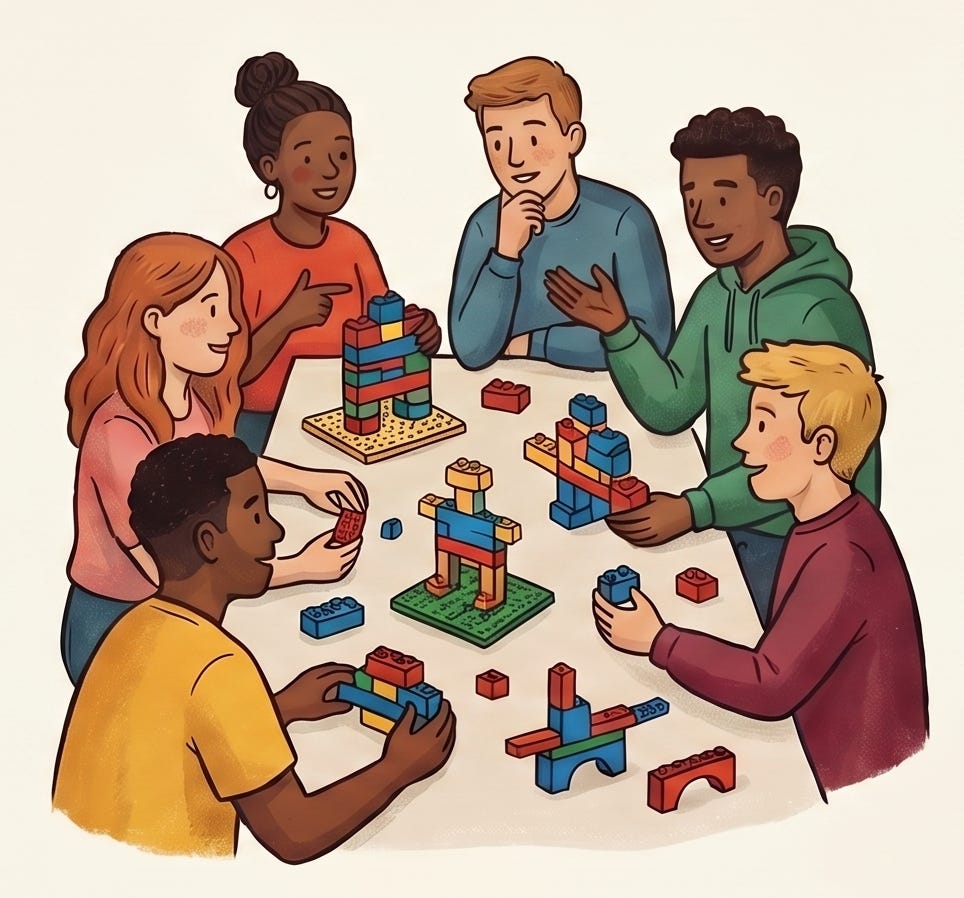
What struck me was how quickly the conversation shifted from the method itself to the possibilities it created. It did not take long before people were imagining how building and play might fit within the kinds of situations youth workers encounter every day. A check-in was an obvious example. Instead of responding to a direct question, a young person might be invited to build a model of how their week had felt. A difficult week might become a tower that feels unstable, a pathway blocked by barriers or a collection of disconnected pieces that refuse to fit together. Rather than searching for the right words, the young person could begin by describing what they had made and, in doing so, discover connections that might not have been obvious when the conversation began.
It was not difficult to imagine the same idea finding its way into one-to-one support. Many mentoring conversations involve competing emotions, conflicting loyalties or uncertainties that have not yet settled into a coherent story. Building offers another route into those conversations because it creates something both people can examine together. Sometimes it may be easier to talk about a situation once it exists as something on the table rather than something held entirely in your head. Questions can then be directed towards the relationships between different elements of the model, what feels stable, what feels fragile and what might need to move for things to look different.
The discussion also drifted towards group work. A disagreement about behaviour, participation or responsibility may look straightforward on the surface while concealing very different experiences beneath it. Building what sits beneath a tension before discussing what should happen next may not produce instant agreement, but it has the potential to reveal assumptions, frustrations and disappointments that had not previously been visible within the conversation.
The Surprise
The work with Motiv8 continues to stay with me because of how quickly the practitioners stopped treating the bricks as a set approach and started treating them simply as youth work. Ideas were borrowed, reshaped and applied to conversations, relationships and situations that mattered within their own settings. Some applications were close to what I had shown them, while others were things I would never have thought to try myself.
Youth work has a long history of borrowing ideas from elsewhere and adapting them to local realities. Approaches developed in education, counselling, outdoor learning and community development rarely arrive unchanged. They are reshaped by context, relationships and the unpredictable nature of working alongside young people. The more I have reflected on the Motiv8 experience, the more I have come to think that this adaptability may be one of the profession’s greatest strengths. Experienced youth workers rarely need another set of instructions to follow; what they often need is permission to experiment, adapt and trust their own judgement.
What began as a conversation about a leadership day eventually became a much bigger reflection on practice, creativity and professional confidence. I still use LEGO Serious Play regularly and I continue to find value in the formal format, but some of the most encouraging examples I have seen have come from watching youth workers take a handful of bricks, a good question and the skills they already possess, then create something entirely their own.