
LEGO® Serious Play® as Practice
What if it isn’t just about workshops?

When the Workshop Becomes the Method
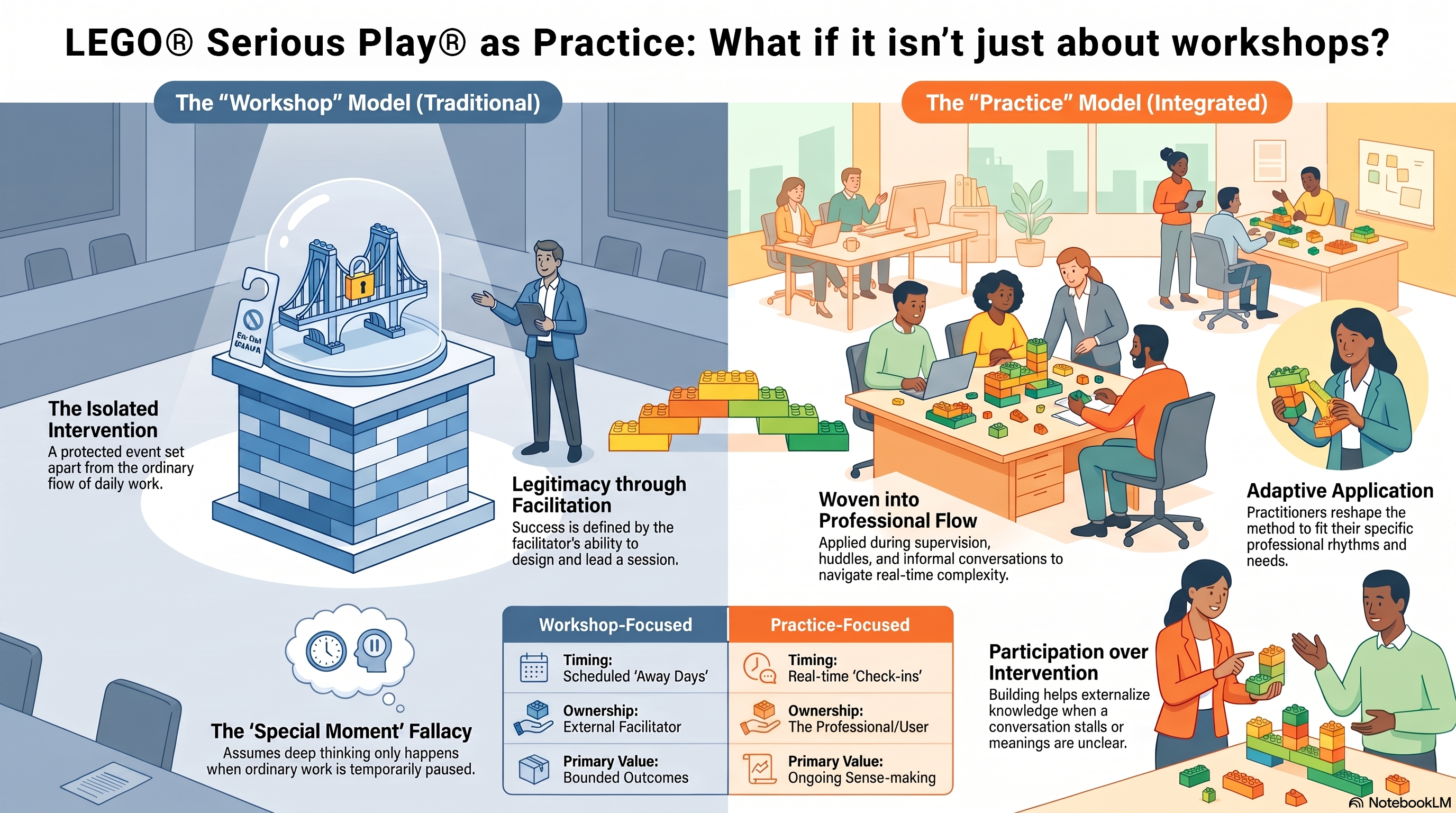
LEGO® Serious Play® is most commonly encountered through workshops, and that is how it is usually presented, taught and sold. It arrives as something set apart from the ordinary flow of work: time is protected, a particular challenge is identified, materials are prepared and someone takes responsibility for designing and facilitating the process. The workshop gives the method a clear beginning and end, as well as a recognisable form through which people can experience what it offers.
This association has developed for understandable reasons, since workshops create conditions in which LEGO Serious Play can be introduced with care and used with a degree of focus that may be difficult to find during a normal working day. Participants can become familiar with building and sharing models, listening to the meanings others attach to them and using what has been made to explore a question together, while organisations can commission an identifiable piece of work in response to a particular need. The workshop has therefore been an effective way of making LEGO Serious Play visible, understandable and accessible.
Its importance extends beyond the experience of participants, because workshops are also where many people first learn how to use LEGO Serious Play and where much of the language surrounding the method has developed. Accounts of practice tend to describe facilitated sessions, while training understandably concentrates on the skills needed to design and lead them. The examples that circulate most widely often involve away days, strategy sessions, team development or other deliberately created spaces in which people step back from their usual activity, and together these experiences establish a strong connection between LEGO Serious Play and the workshop form.
That connection can become difficult to notice precisely because it feels so natural. The workshop is no longer seen simply as one setting in which LEGO Serious Play can be useful; it begins to appear as the form the method is supposed to take. This does not diminish the value of workshops or suggest that they have somehow been used incorrectly, but it does raise a question about how the context in which a practice is encountered shapes our understanding of what that practice is, what we expect it to deliver and where we imagine it belongs.
When Form Begins to Define Legitimacy
Once the workshop has become the form through which LEGO Serious Play is recognised, it begins to influence more than the circumstances in which the method is used. It establishes expectations about what counts as legitimate practice, what kinds of outcomes are worth noticing and what competence is supposed to look like.
Its value is consequently judged through what happens within the workshop and what can be attributed to it afterwards. People look for evidence that the process has helped them understand an issue, communicate more openly, identify possibilities or reach a clearer sense of direction. These are reasonable expectations, but they make the workshop the unit through which value is recognised, leaving uses that are smaller, less formal or woven into an existing piece of work harder to notice because they do not produce the same visible event or clearly bounded outcome.
The workshop frame also shapes what those trained in LEGO Serious Play believe it means to be competent. Expertise can become closely associated with the ability to design and lead a successful session, manage group dynamics, sustain participation and bring the process to a useful conclusion. That understanding gives facilitation a central place, but it can make other forms of judgement less visible, including knowing when a model might help someone think, adapting an approach to fit an emerging need or creating an application that belongs within the flow of existing work.
Over time, this creates a subtle circularity in which workshops provide the examples through which LEGO Serious Play is understood, while that understanding encourages people to keep looking for workshop-shaped opportunities in which to use it. The method becomes associated with moments when ordinary work is paused so that something special can happen, leaving less visible the possibility that its value might also lie within the ordinary work itself, where people are already trying to make sense of situations, understand one another and decide what to do next.
The Work of Understanding Is Already Underway
If LEGO Serious Play has come to be associated with moments when ordinary work is paused, then it is worth paying closer attention to what people are already trying to do within the flow of that work. They are making sense of incomplete situations, interpreting what others mean, working through disagreement, testing assumptions and deciding how to act when there is no single clear account of what is happening. These activities are not separate from the work itself; they are woven into the conversations, decisions and relationships through which the work is carried out.
A discussion about priorities may appear to be concerned with planning while also revealing that those involved hold quite different understandings of what matters and why. A conversation about a colleague’s behaviour may be less about the behaviour itself than about the competing interpretations attached to it, while even a routine meeting can depend on whether people have developed a sufficiently shared picture of the situation before them. Because this activity is dispersed through supervision, handovers, informal conversations, collaborative problem-solving and the quieter reflection that precedes a decision, it can be difficult to recognise as a distinct part of working life. People may sense that they are talking past one another, that an issue remains unresolved or that something important has not yet found a form in which it can be discussed, but the work continues and the opportunity to examine those differences may pass.
Many of the qualities attributed to LEGO Serious Play in workshops relate directly to these ordinary difficulties. The method can help people give form to what they know, externalise an experience that is difficult to explain, compare perspectives and develop a more shared understanding of a situation. Workshops do not create the need for those things; they create protected conditions in which the need can be addressed with greater attention and intention. The more significant distinction, therefore, may not be between meaningful thinking in workshops and routine activity in work, but between situations in which people are given a method for working with complexity and situations in which they are expected to manage without one. The forms of sense-making, interpretation and shared understanding that LEGO Serious Play supports are already present throughout work, which raises the possibility that the method might have a place within those practices rather than being reserved for occasions when everyday work is temporarily set aside.
From Intervention to Participation
Once it becomes clear that the forms of sense-making, interpretation and shared understanding supported by LEGO Serious Play are already present throughout work, the workshop begins to look less like the method’s natural home and more like one particular way of creating the conditions in which those activities can be approached deliberately. This does not make the workshop less valuable, but it changes what we notice. Rather than asking how the effects of a workshop might be carried back into work, we can begin to ask where similar forms of thinking and communication are already needed within the work itself, and what it would mean for LEGO Serious Play to become part of those practices.
That question is not straightforward because LEGO Serious Play is so often encountered through a workshop form that it can be difficult to imagine it otherwise. The method arrives with a beginning and an end, a defined purpose, a facilitator and a group brought together for a particular reason. When those conditions are repeatedly treated as normal, it becomes easy to assume that they are also necessary. The possibility that LEGO Serious Play might appear in a supervision session, a planning conversation, a reflective discussion between colleagues or a moment of individual thinking can seem like a departure from the method rather than a different way of using it.
Part of the difficulty lies in how workshops organise attention. They create a visible event in which time is protected and participants are invited to focus on a question with a degree of concentration that everyday work rarely permits. The value of LEGO Serious Play therefore becomes associated with those exceptional conditions. Yet the need to understand a situation, explore different interpretations or develop a shared picture of what is happening does not arise only when time has been set aside for it. These demands appear throughout working life, often in less predictable forms and under less favourable conditions.
Seen from this perspective, the question is not whether LEGO Serious Play can be transferred from workshops into work. The activities it supports are already there. The more interesting question is whether the method can be understood as one way of participating in those activities rather than as a separate intervention that takes place outside them. Asking the question in this way shifts attention away from the workshop as the defining frame and towards the practices through which people make sense of situations together. It is this shift that opens the possibility of seeing LEGO Serious Play not simply as something delivered through workshops, but as something that can become part of practice itself.
When the Method Enters the Work
To see LEGO Serious Play as part of practice is to begin not with the design of a workshop, but with the situations in which people are already trying to understand something, express something or work through something together. In those moments, the question is not how to introduce the method in its fullest form, but whether building might help the work move. Someone involved in the work may notice that a conversation has stalled, that different interpretations are sitting alongside one another without meeting, or that another person is struggling to give shape to an experience that is difficult to explain. LEGO Serious Play becomes relevant through that judgement, as one possible way of working within the situation rather than as a separate process imposed upon it.
My work with Motiv8 began with the intention of enabling experienced youth workers to encounter LEGO Serious Play and explore how they might use it within their own practice, rather than training them to reproduce a fixed workshop process. I brought the bricks, some activities and an approach shaped through learning and development, while they brought years of experience in helping young people reflect, communicate, navigate relationships and make sense of their lives. As they connected the method with the unpredictable conversations and situations that make up youth work, building began to find a place within check-ins, one-to-one support and tensions within groups. The important development was not that I had created a version of LEGO Serious Play for youth work, but that the youth workers were able to take what was useful, reshape it around the realities of their own settings and create applications that belonged to their practice.
What happened at Motiv8 is difficult to describe if the workshop remains the measure of what counts as proper use. Some of the applications stayed close to activities I had introduced, while others moved in directions I would not have anticipated, because they were being shaped by youth workers who understood the relationships, rhythms and uncertainties of the work from within. The method did not disappear in that process, but neither did it remain untouched. Its recognisable qualities were carried through the use of building to give form to experience, make meaning available for discussion and create something that people could examine together, while the surrounding form changed according to what the work required.
This is where understanding LEGO Serious Play as practice becomes more than a change of language. It places the development of the method partly in the hands of those who use it, because practice grows through attention, judgement and adaptation rather than through repetition alone. People draw on what they have learned about LEGO Serious Play, but they also bring knowledge formed through the work itself, discovering what becomes possible when the method encounters circumstances, pressures and purposes that were never part of its original design. Not every adaptation will be equally thoughtful or effective, and skill, care and reflection remain necessary, but the practice can only develop fully when those using it are trusted to do more than deliver a form created elsewhere.
Ownership Without Imitation
Making LEGO Serious Play your own begins when the method has become sufficiently familiar that it no longer has to be held in place by the visible structure through which it was first learned. Attention can then move away from reproducing a workshop and towards understanding what the situation requires, how the people involved are responding and whether building might help something become available for thought or discussion that would otherwise remain difficult to express. What has been learned remains present, but is carried through judgement rather than through the repetition of form.
That ownership depends on recognising what gives the practice its character when the surrounding conditions change. A brief use of building in supervision, a model introduced during an uncertain conversation or an activity developed around a particular piece of work may look very different from a facilitated workshop while still allowing experience to take material form, meaning to become available to others and something previously difficult to articulate to be examined together. The continuity lies in understanding what the building is making possible and in using it with enough care that it becomes part of the work rather than an engaging interruption to it.
As LEGO Serious Play becomes part of someone’s way of working, authority begins to move beyond those who teach the method or design workshops around it. The people closest to the work already possess forms of knowledge that the method does not provide: they understand the pressures under which decisions are made, the relationships on which delivery depends, the risks that have to be judged and the practical consequences of getting something wrong. When they reshape LEGO Serious Play around those realities, they are doing more than applying a method created elsewhere, because their use of it reveals possibilities that could not have been designed in advance and makes them participants in what the practice becomes.
Who Gets to Shape the Practice?
If LEGO Serious Play is understood as a practice rather than primarily as a workshop method, then the boundaries that once seemed clear begin to loosen. The difference between a formal session and everyday work becomes harder to maintain because the forms of sense-making, interpretation and shared understanding supported by the method are no longer treated as things that happen only when time has been set aside and a process has been designed around them. They are recognised as part of the work people are already doing, which means that a brief use of building in supervision, a model introduced during a difficult conversation or an application developed for a particular setting can be understood as part of the practice rather than as a reduced or incomplete version of a workshop.
That shift also changes how the method develops, because workshops are no longer the only places from which useful knowledge about LEGO Serious Play can emerge. Facilitation skills, session design and carefully structured processes remain important, but they are joined by knowledge formed through using building amid the less controlled conditions of work, where conversations alter direction, commercial and operational pressures intrude, decisions have consequences and whatever is introduced must prove useful alongside everything else that needs to be done. The people using LEGO Serious Play in those circumstances encounter possibilities and limitations that could not have been fully anticipated in advance, and their work contributes to the continuing development of the practice rather than merely demonstrating how an established method can be applied.
Workshops therefore remain a significant part of LEGO Serious Play without having to define its limits. They offer protected time, focused attention and opportunities to introduce the method with care, but they can be understood as one expression of a broader practice rather than the form against which every other use must be judged. Once that distinction is made, the question is no longer simply how LEGO Serious Play can be taken beyond the workshop, because the workshop is no longer imagined as the place from which the method must travel. The more useful question is what may become possible when the people closest to the work are able to let LEGO Serious Play take shape within it.
The Limits of Control
The deeper consequence of treating the workshop as the natural form of LEGO Serious Play may be that we have built our understanding of the method from the most visible examples of its use. Workshops are easy to describe, teach and evaluate because they produce a recognisable event, whereas the quieter uses that become woven into supervision, reflection, one-to-one work or an unfolding conversation are much less likely to be recorded or shared. What appears to be the established shape of LEGO Serious Play may therefore reflect not only where the method is most valuable, but where its use is easiest to notice, leaving us with an account of the practice that is more partial than we tend to admit.
Once that possibility is taken seriously, the question is no longer simply whether LEGO Serious Play can be used beyond workshops, but who gets to decide what counts as legitimate use when it is. People may find their own ways of using LEGO Serious Play to support communication, understanding and shared sense-making while leading organisations, managing money and risk, designing products, making and selling things, delivering services, caring for others or solving operational problems, and those uses may bear little resemblance to the methods through which many facilitators were trained without being lesser forms of practice.
The real challenge may be whether those of us who have learned to recognise expertise through the design and control of workshops are willing to recognise expertise when it appears in forms we did not design and can no longer control.
I really enjoyed this piece. It made me think that for LEGO® SERIOUS PLAY® to become a true practice, it should not remain something teams experience only in occasional workshops.
Perhaps, after a few facilitated sessions, some people within the organisation could become confident enough with the foundations of the method to carry it forward internally. With their guidance, LSP could gradually become part of the team’s everyday way of thinking, reflecting and making decisions.
I would love to see LEGO® SERIOUS PLAY® kits become a permanent feature of meeting rooms and team tables, ready to be used whenever a topic needs deeper exploration. Considering how quickly 100% participation can bring the whole table into the conversation and move a group towards clarity, the impact could be remarkable.
That, to me, is when LSP truly becomes a practice rather than a workshop.