
The Bricks vs. The Method
Are We Misunderstanding Open Source?

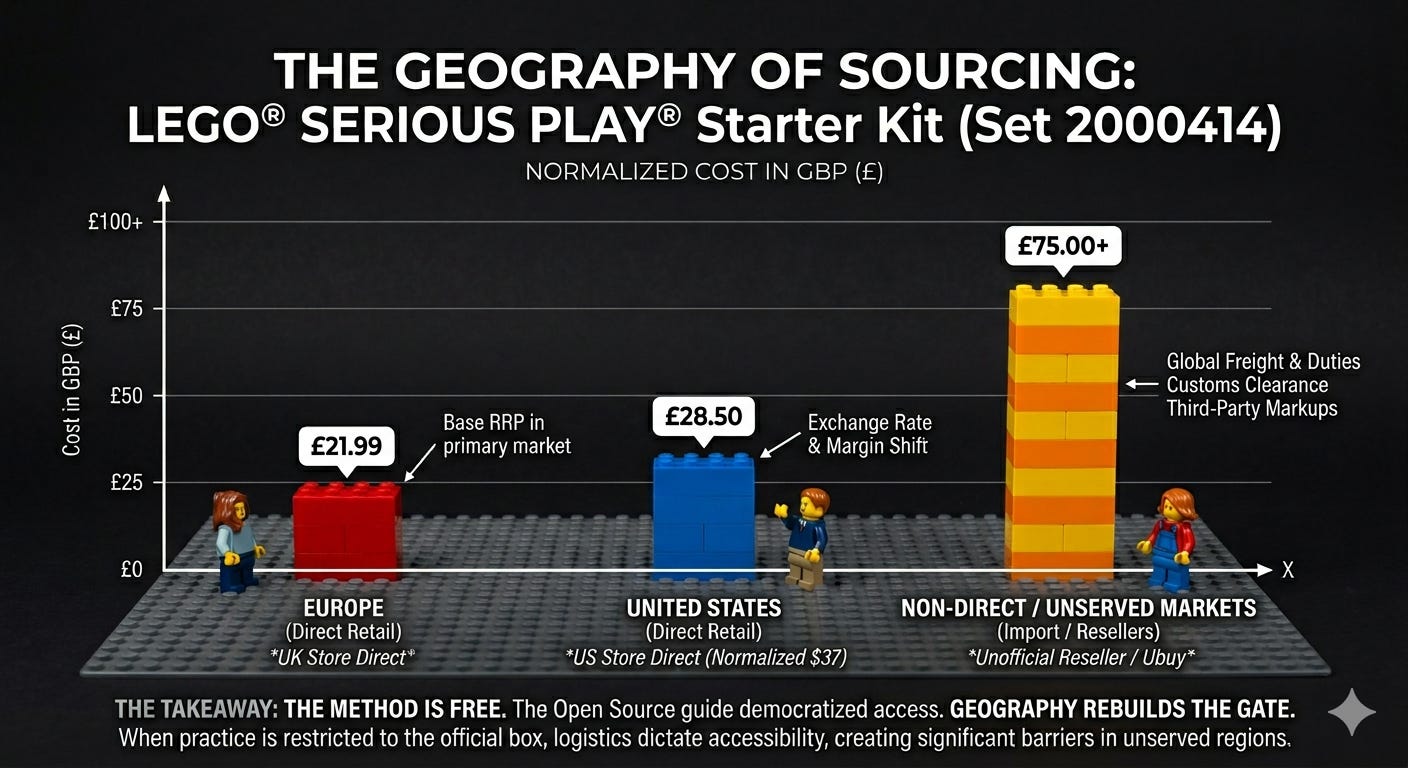
I’ve been reflecting on a couple of comments posted on LinkedIn from my recent post about LEGO® Serious Play® (LSP). The conversation quickly hit a familiar wall around cost, with a practitioner pointing out that while the facilitation framework is freely available, the physical bricks can still be expensive and hard to access in regions with high tariffs or lower purchasing power.
That concern is real. In some contexts, official LEGO materials are not a small expense and it would be glib to pretend otherwise. What worries me is the way the conversation can slide from the price of materials into a much larger claim about access to the method itself. Those things are connected, but they are not identical.
Confusing Corporate Consulting with Philanthropy
The expectation that LEGO should make LSP materials cheaper does not appear from nowhere. Through initiatives such as LEGO Education and the LEGO Foundation, the company has spent years talking about access, learning and the importance of play. It is understandable that some practitioners carry those expectations into discussions about LEGO Serious Play.
However, those philanthropic arms are explicitly designed to support children, primary classrooms, and developmental equity, not to subsidise the toolkits of adult corporate consultants. What begins as a discussion about the cost of materials can gradually become a discussion about access to the methodology itself, as though one necessarily determines the other. The open source release complicates that assumption because it changed who could use the method without first seeking permission to do so.
The Open Source Guide Was the Real Shift
The larger act of democratisation was not a reduction in the price of plastic. It was the release of the method. In 2010, LEGO moved LEGO Serious Play into a community based model under a Creative Commons licence. Before that, access to the method was tied much more closely to an official certification route and a network of consultants. After that shift, practitioners no longer had to pay LEGO a licence before using the methodology.
That changed the centre of gravity. LEGO did not simply make a document available as a gesture towards openness. It released the principles, facilitation process and underlying framework in a form that people could study and use without first passing through a proprietary route. The open source guide did not create instant mastery, and it did not remove the need for practice, judgement or care, but it did remove a significant permission structure from the method.
The Process Is Not Owned by the Box
The guide does not make materials irrelevant. LEGO Serious Play depends on people building physical models, using metaphor and making their thinking visible through objects. The bricks help because they are familiar, modular, durable and easy to rework while someone is thinking. Those qualities support the method, and it would be too easy to dismiss them as though any pile of objects would automatically do the same job.
The mistake comes when the material support becomes confused with the source of the method’s authority. The value is not produced by the logo on the box. It is produced through the relationship between the question, the build, the story and the listening that follows. The bricks provide a way for thought to become visible, but the work happens in the meaning people attach to what they have made and in the care with which the facilitator holds that process.
That distinction matters for accessibility. Where official kits are too expensive, practitioners can still work responsibly with second hand LEGO, shared pools of bricks, carefully chosen loose parts or compatible materials, provided the activity still allows people to build, alter, explain and make meaning through physical models. The question is not whether every session uses an official set. The question is whether the materials are good enough to serve the method without narrowing who gets to take part.
The Real Gatekeeping Question
The argument about cost is important, but it can hide a deeper question about authority. LEGO released the method, yet parts of the wider community still seem to behave as though the practice remains inside the branded materials, the inherited training routes or the old consultant culture. That is where the gatekeeping risk begins to reappear.
An open source guide does not make someone a skilled facilitator. It does not replace experience, ethical judgement or the discipline of learning the method properly. What it does change is the starting point. The starting point is no longer permission from LEGO, or approval from a closed professional route, but the responsibility of the practitioner to study the method carefully and use it well in their own context.
The Takeaway
True accessibility will not be solved only by asking a multinational company to lower the retail price of its materials. That may help some people, but it does not touch the deeper question of whether practitioners themselves are still treating the method as though it belongs to the official box.
If LEGO removed a gate in 2010, then we need to be careful not to rebuild it through habit, status or brand loyalty. The power of LEGO Serious Play has never rested solely in the plastic. It rests in the quality of the facilitation, the seriousness of the question and the honesty of the conversation in the room. The more interesting question is why so many practitioners still talk as though the method remains trapped inside the box.
Great reflection, Ben. You touch a crucial point about how the real democratization happened in 2010 when the method was released. However, I would like to add a variable that complements your article and explains why "so many professionals still talk as if the method remains stuck": the school industry and the false scarcity of authority.
Although the guide is open source, "schools" have emerged that started operating as if they were the official owners and the only real references. It's a lie they have positioned very well in the market, reaching the point of publishing their big conventions at LEGO House as if they were endorsed by the "high priests" of the methodology.
This leads us to several structural problems the community needs to start questioning:
1. The myth of the $3,000 USD and the stagnant orthodoxy
The price of these trainings oscillates around $3,000 USD, which is a barbarity. This figure creates a collective imaginary that this is the "official certification." In 15 years they haven't reinvented the model, nor have they torn down those economic barriers; on the contrary, they have erected themselves as the only owners of "the truth," keeping the method stuck in their own orthodoxy.
2. A business of royalties and theatricality, not competence
Why that high price? Largely because they pay a royalty within their certification scheme. They have become perfect actors to replicate a theatrical experience flow of 3 to 4 days. But what happens after? They don't monitor or validate a real graduation certificate, nor much less the practical applicability of their students in the real world. It's a business of replicating a script, not a guarantee of facilitation competence.
3. False authorship and fear of integration
The most worrying thing is the discourse of these so-called trainers. They attribute authorship of concepts and systems (like landscapes and future scenarios) that aren't even registered to their name. They use a perfect discourse, rehearsed like a play, to explain the Core Process, but they flatly refuse to talk about how to integrate LSP with other methodologies. The reason? Integrating it with other disciplines would break their monopoly.
They forget that the real expert isn't the LSP facilitator, but the area specialist who applies it. An expert with 20 years in Agile methodologies, for example, will always have better uses, readings, and challenges for the methodology than the basic and orthodox vision of a facilitation manual.
As you rightly conclude in your article, the power of LEGO Serious Play has never resided only in the plastic. But today we must add that it doesn't reside in the $3,000 certificates either. The real challenge is tearing down the invisible walls that this "certification" industry has built to maintain their status. The method is free; it's time for the practice to also be freed from its false guardians.
Thanks for opening this debate, Ben.